
A second brain starts in your pocket
Tiago Forte's CODE method in four steps, and why the best material for it rarely comes from a screen.
4 min read
Somewhere on the walk along the canal, you work out how the talk should open. Not with the charts. With a story. You can hear the first sentence. You also know that by the time you're back at your desk, it'll be a vaguer version of itself.
Tiago Forte built a method around moments like that. He began Building a Second Brain as an online course and turned it into a book in 2022. The idea: stop asking your memory to hold every idea, insight and useful thing you come across. Keep them in one trusted digital place, a "second brain", and use it to make things. In Forte's words: "A Second Brain is a factory not a warehouse."
CODE: the whole method in four steps
- Capture: keep what resonates. Don't save everything. Save what strikes you: a line from a book, a phrase a client used, your own half-formed idea. Forte also suggests keeping a short list of open questions you care about (he borrows the idea of "favorite problems" from the physicist Richard Feynman), so you notice what's relevant when it turns up.
- Organize: by action, not by subject. Sort notes by where they'll be useful next. Forte's system for this is PARA:
- Projects: efforts with a goal and an end, such as a talk, a renovation, a proposal.
- Areas: ongoing responsibilities, such as health, money, a team.
- Resources: topics you're interested in.
- Archives: whatever from the other three is no longer active.
Start with your active projects. The rest can wait. - Distill: find the essence. Each time you come back to a note, make it a little easier to use next time. Forte calls this Progressive Summarization: bold the key passages, highlight the best of the bold, and for the few notes that matter most, write a short summary at the top in your own words.
- Express: make something. Use your notes to produce work: an email, a draft, a plan, a sketch. Forte calls the small reusable pieces "Intermediate Packets" and suggests ending each work session, fifteen minutes or three hours, by finishing one.
That's the method. Which tools you use matters less than the habit of getting from step one to step four.
The honest objection
Second brains have a well-known way of failing: they turn into a pile. In 2014 Christian Tietze called it the collector's fallacy, the feeling that having something is the same as knowing it. In 2025 the writer JA Westenberg deleted years of notes, highlights and reading lists and wrote: "I don't want to manage knowledge. I want to live it."
Forte's own rules point the same way. Keep only what resonates. Run a factory, not a warehouse. Capture less, use more.
Where the pocket notebook comes in
Most capture tools are built for clipping: articles, web pages, highlights. But your best material often isn't on a screen. It's what a client said, the idea on the canal path, the sketch you make before you have the words. That's where a pocket notebook belongs in CODE: at the very first step, for what only you can capture.
It also brings a useful bit of friction. Fount notes has no web clipper, so almost everything in it you typed, drew or said yourself. That's a small, built-in check on collecting for its own sake.
Doing it with Fount notes
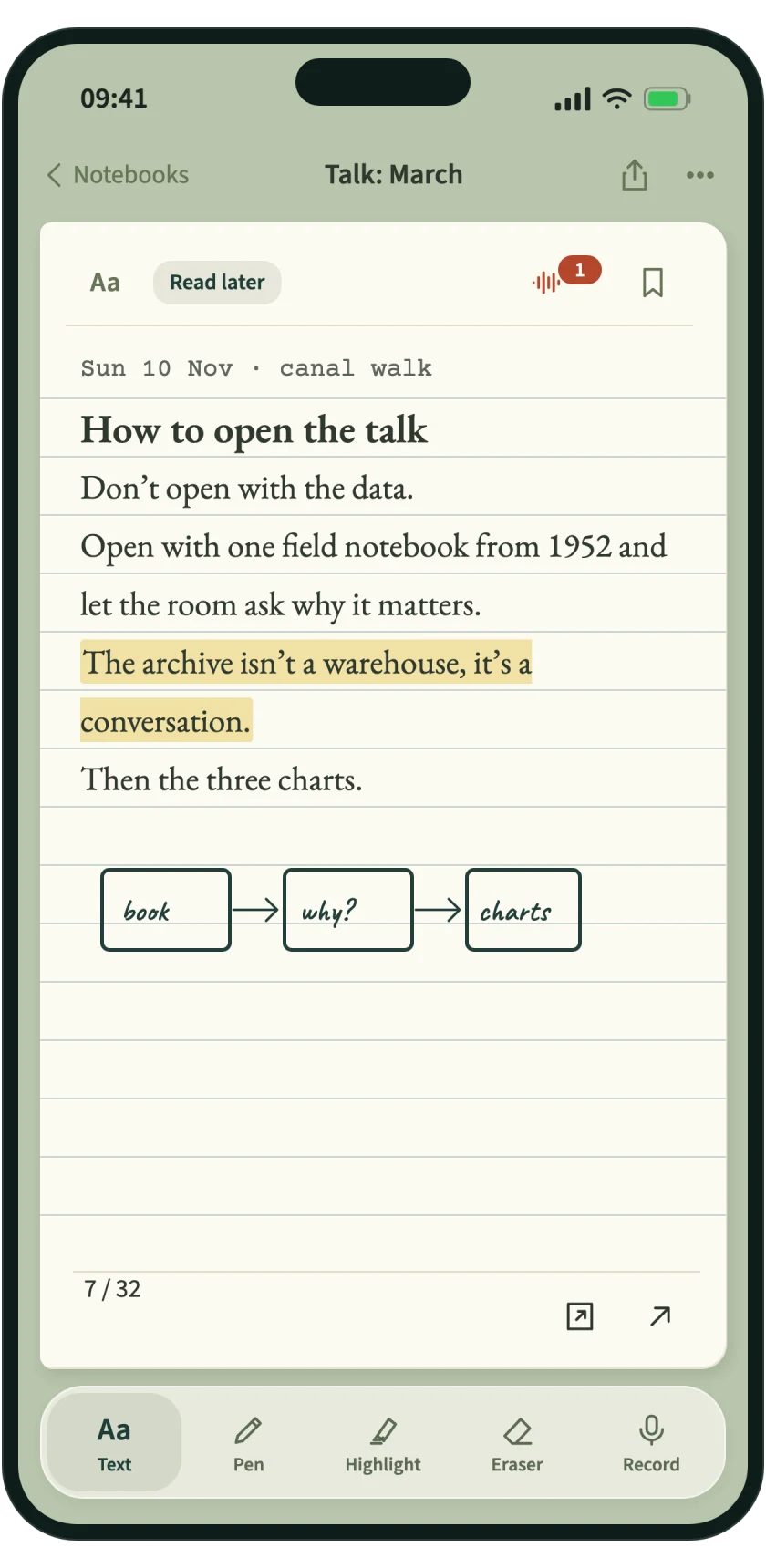
Capture. Type, sketch or speak, one idea per page. On a walk, say the sentence while you still have it; on supported iPhones a recording can be transcribed. With your hands full, ask Siri to "Add a note in Fount notes."
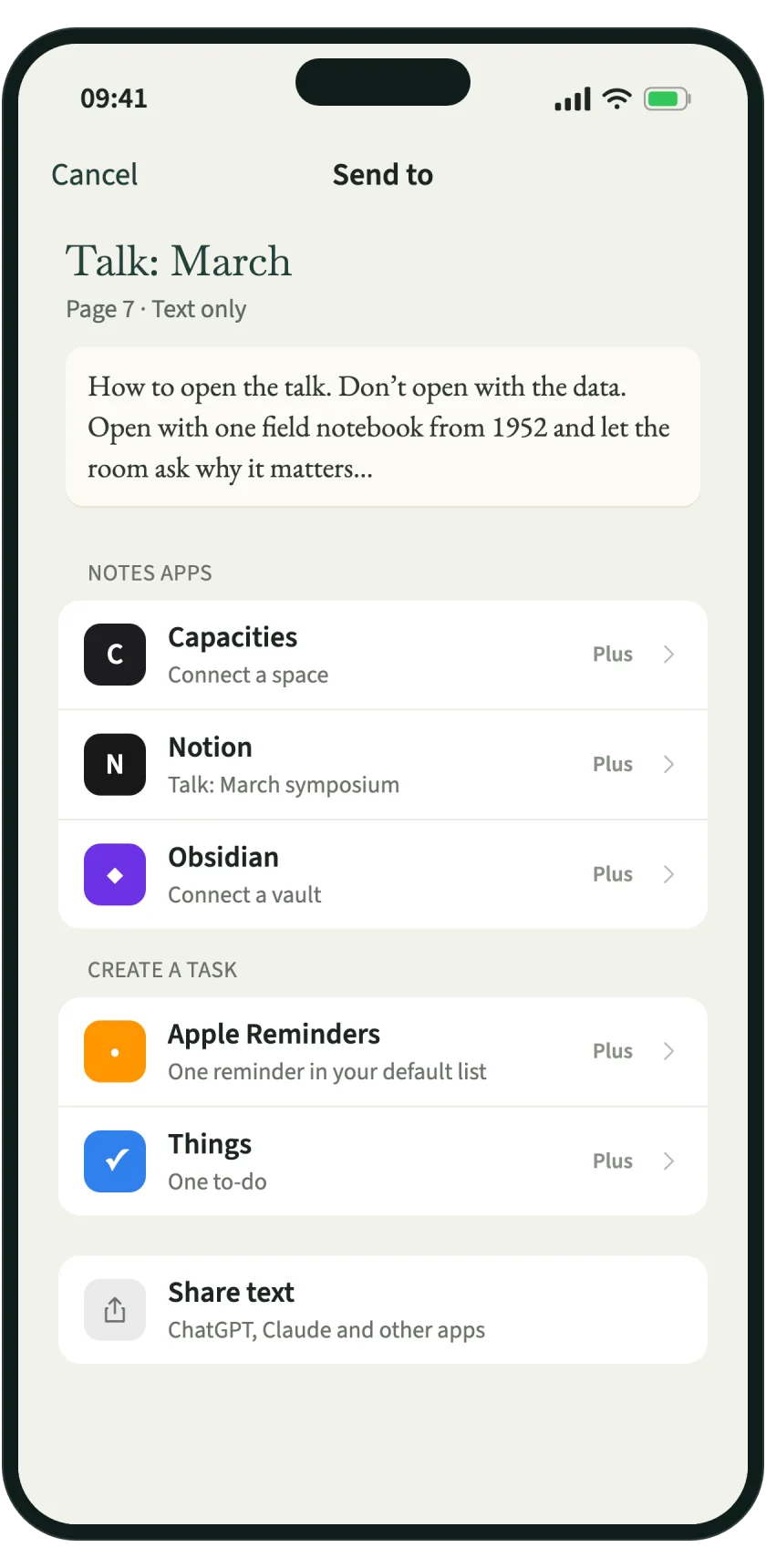
Organize. With Fount Plus you can keep a notebook for each active project and send a page to Notion (into the database you choose), Capacities, or Obsidian (as a Markdown note in your vault). No retyping. Only the text travels; sketches and recordings stay in Fount notes, and the page stays in your book. Without Plus you keep one book. Search finds any word in it later, with the page number, and you can share a page's text with other apps.
Distill. Highlight the line that matters, on your own page. That's the first layer, done where you wrote it. For pages worth another look, tap the bookmark and choose Read later or a time. Review brings them back one at a time, so you can highlight again or send the page on.
Express. When you sit down to make something, search your book for the project's key word, or go through Review. On compatible iPhones you can also open Notebook chat and ask about a book you choose; Apple's on-device model answers from your own pages.
Where something else does it better
Fount notes isn't your second brain. It has no PARA folders, tags, links between notes or sync. Long-term organizing and distilling belong in Notion, Capacities or Obsidian, or on paper if that's your system. If you mostly save articles and highlights, a read-later app or your notes tool's own clipper does that better. Fount notes is for the moment the thought arrives.
Tomorrow
On the first page of your book, write down three questions you keep coming back to. For one day, put every thought that touches one of them on its own page. In the evening, page back and highlight the one line on each page that's still worth something. That's Capture and the first layer of Distill. Send the best page to the project it belongs to, or leave it where it is until you need it.
Sources
- Tiago Forte, "Building a Second Brain: The Definitive Introductory Guide" — fortelabs.com
- Tiago Forte, "The PARA Method" — fortelabs.com
- Tiago Forte, "Progressive Summarization" (2017) — fortelabs.com
- Tiago Forte, Building a Second Brain (Atria, 2022)
- Christian Tietze, "The Collector's Fallacy" (2014) — zettelkasten.de
- JA Westenberg, "I Deleted My Second Brain" (2025)