
The slip box, and the pocket in front of it
Niklas Luhmann filled six cabinets with 90,000 notes. Every one of them started as a thought that had to be caught first.
4 min read
Niklas Luhmann, a German sociologist, kept a box of paper slips for more than forty years. By the end it filled six wooden cabinets: about 90,000 small notes in two collections, the first begun around 1951, the second kept until 1996. The Niklas Luhmann Archive at Bielefeld University has scanned them, and you can read his slips online.
He called it a Zettelkasten, a slip box. In 2017 Sönke Ahrens turned Luhmann's practice into a working method in How to Take Smart Notes, and that's how most people know it now. The labels below (fleeting, literature, permanent notes) are Ahrens's words. The idea underneath is Luhmann's.
The idea: you don't file notes by topic. You write one thought per slip, in your own words, and you place it next to the slip it continues. Over time the box grows its own structure. When you come back, it can still surprise you. In a 1981 essay Luhmann wrote that communication only works if both partners can surprise each other. He meant the box.
The whole system, in five steps
1. Catch fleeting notes. A thought on the train, a question in the shower. Write it down quickly, in any form. These notes are temporary. Their only job is to keep the thought alive until you can work on it.
2. Write literature notes while you read. When something in a book matters to you, write a few lines in your own words, with the page number. Keep them short and selective. Luhmann's own reading notes were often a few keywords and page numbers on the back of a slip.
3. Turn them into permanent notes. Go through your fleeting and literature notes, ideally once a day, as Ahrens puts it, before you forget what you meant. For each idea worth keeping, write one new note: one idea, full sentences, as if for someone who wasn't there. Then throw the fleeting note away. Its work is done.
4. Place and connect. Put each permanent note behind the one it relates to most, and give it an address. Luhmann used numbers that branch: a note that picks up a point from slip 1,1 becomes 1,1a and sits between 1,1 and 1,2; a side thought to that becomes 1,1a1. Add a reference to any other note it talks to, however far away. Then add a keyword to a short index that points to a few entry points, not every mention. The references do the rest.
5. Write from the box. After a while, clusters appear: a run of slips that already argue something. Lay them out, put them in order, and draft. You never start from a blank page.
Where the pocket notebook comes in
Everything in the box comes in through step one, and step one is the fragile part. The thought arrives when the box is at home, the book is closed and there's no table.
That's the pocket notebook's job. It doesn't need to be tidy. It needs to be there, open in seconds, and emptied soon. A fleeting note you read the next day still makes sense. One you find three weeks later often doesn't: you see the words but not the thought. So keep the window short, a day or two.
Even Luhmann didn't only put finished thoughts in his box. On one of his slips he notes, roughly, that you shouldn't wait until everything is clarified, because putting off checking and deciding is also a matter of pace. That's a useful permission. The pocket is for unfinished thoughts.
Doing it with Fount notes
Use Fount notes as the pocket, and keep the box somewhere else.
Catch. Open a page and type the sentence. On a walk, record it instead; on supported iPhones a recording can be transcribed. If the idea is a shape before it's a sentence, sketch it with your finger. Or tell Siri "Add a note in Fount notes" without opening anything.
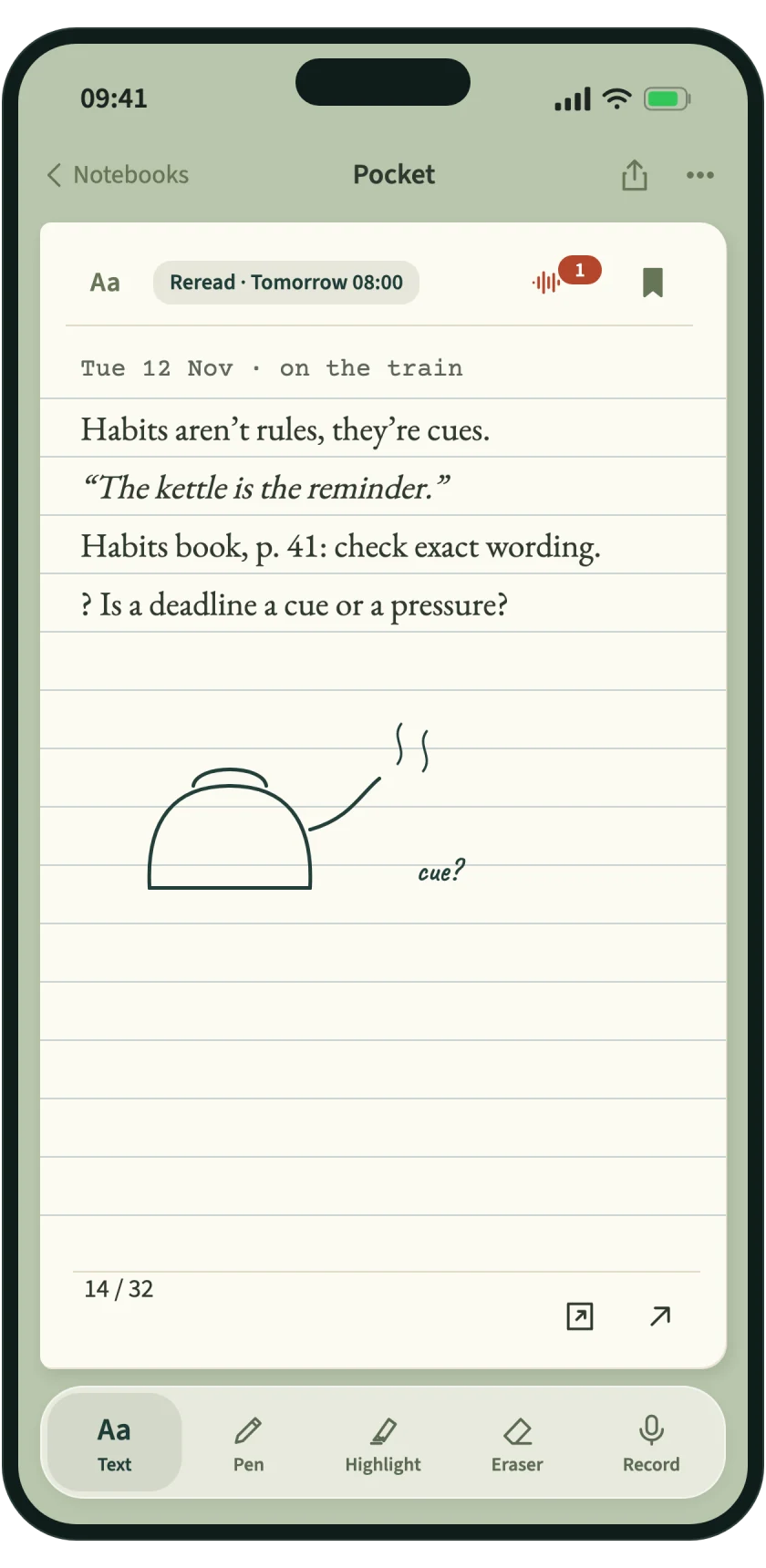
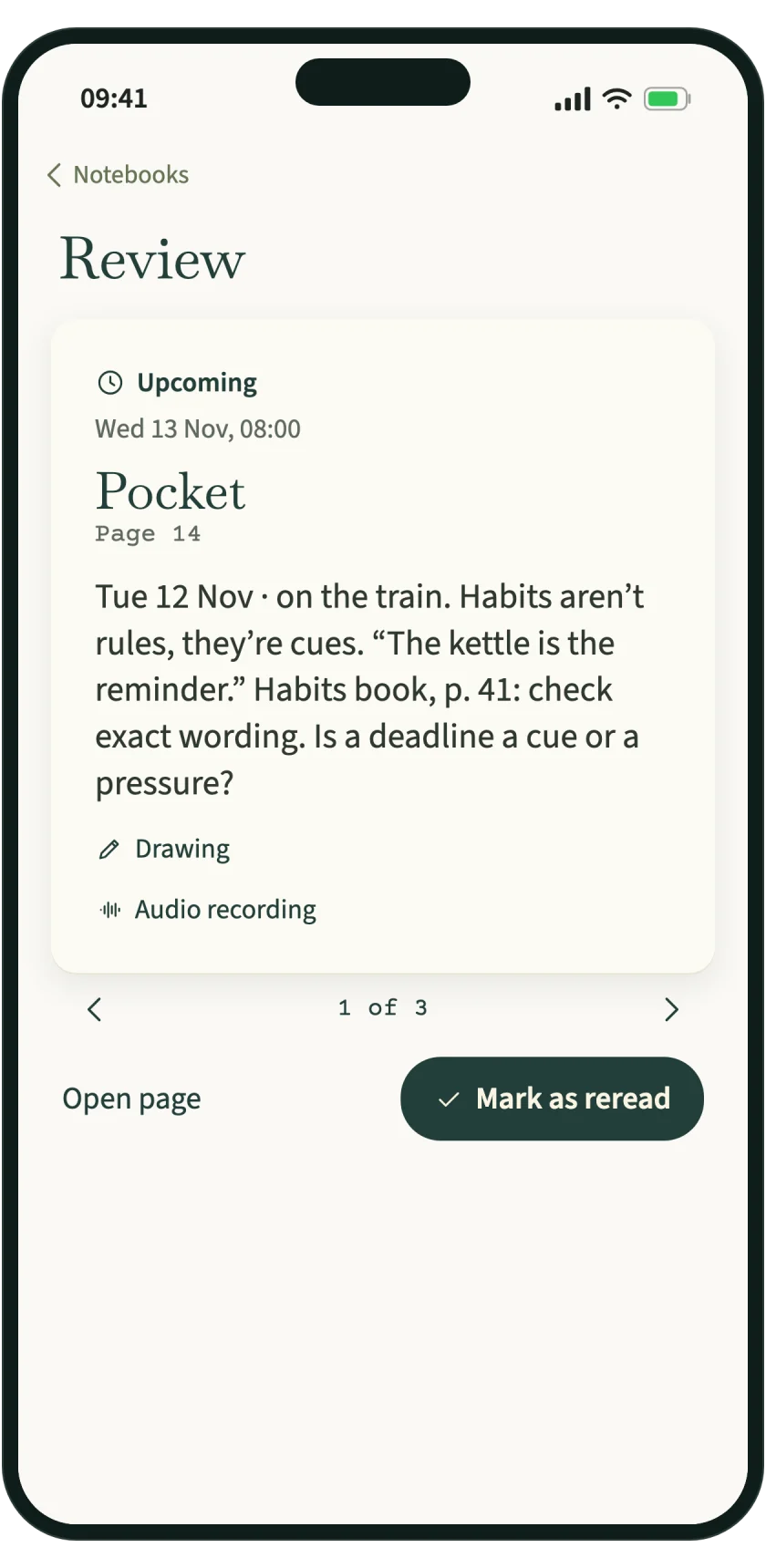
Keep the window short. Tap the bookmark and set a reminder for tonight or tomorrow morning. Those pages gather in Review, one at a time, so the processing gets a place in your day. Tap Mark as reread once you've turned a page into a permanent note.
Find a half-remembered line. Search looks through all your books and shows the book and page.
The permanent box lives elsewhere. Fount notes has no links between pages and no way to give a page an address like 1,1a, and it isn't meant to be your slip box. Write permanent notes on paper slips, as Luhmann did. Or, if your slip box is in Obsidian, use Fount Plus to send a page's text to your vault as a Markdown note, and rewrite and link it there. Sketches and recordings stay in the book.
Either way, the page stays in your book. Nothing has to be copied over to make the system complete. The pocket just has to be emptied into the box.
One honest note: paper is better for step four. Physically placing a slip behind another, seeing its neighbours, makes you decide where a thought belongs. Don't try that on a phone.
Tomorrow
Catch three thoughts in Fount notes, whatever comes. Set a reminder for the evening. When the page comes up in Review, take the thought that still interests you and write it out as a full sentence on a card, as if for a stranger. Number it 1. Then put the next one behind it.
Sources
- Johannes F. K. Schmidt, "Der Zettelkasten Niklas Luhmanns als Überraschungsgenerator" (2015) — Niklas Luhmann-Archiv, Bielefeld University
- Niklas Luhmann, slips ZK II 9/8 and 9/8a2 — niklas-luhmann-archiv.de
- Niklas Luhmann, "Communicating with Slip Boxes" (1981, English translation)
- Sönke Ahrens, How to Take Smart Notes (2017)