
The commonplace book, with Locke's index in your pocket
Catch the line, give it a head, find it again. A four-part system that worked for centuries, and still does.
4 min read
For centuries, readers kept a book of other people's sentences. A line from a sermon, a recipe, a proverb. Schoolboys were taught to do it; scholars, poets and doctors kept at it all their lives. It was called a commonplace book, after the loci communes, the "common places" or headings under which you filed what you found.
The trouble was always the same. Collecting is easy. Finding it again, years later, is not.
In 1685 the English philosopher John Locke described his solution in a letter to his friend Nicolas Toinard. It appeared in French, anonymously, in July 1686, in Jean Le Clerc's journal Bibliothèque universelle et historique. The English translation followed in 1706, two years after Locke's death, as A New Method of Making Common-Place-Books. Locke said he'd been using the method for twenty-five years.
His answer to the finding problem fits on two pages.
The whole system, in four parts
1. Collect: the passage and where it came from. When something is worth keeping, write it down with its source, precisely enough to find it again. Locke was strict: author, title, size, place and year of the edition, and the total number of pages. Next to each passage he noted the page. With those two numbers, he explained, a little arithmetic finds roughly the same spot in any other edition. Many people today add one thing: a line of their own underneath. Why did this stop you?
2. Give it a head. Each entry goes under a heading of one word. Locke's rule was to choose "some important and essential Word to the matter in hand". Not a category you invent in advance, but the word the passage is really about. He wrote the head large, out into the margin, so heads stand out as you turn the pages.
3. Index the heads. This was Locke's invention. He ruled the first two facing pages into a grid: twenty letters of the alphabet, each with the five vowels beside it. A hundred small boxes. A head is filed by its first letter and the first vowel after it, so Epistola goes under E–i. The box holds the number of the page where that group of heads lives. For a new head, look in its box: if there's a number, go there and write; if not, take the next empty spread and put its number in the box. That's the whole index, however thick the book gets.
4. Reread and use. A commonplace book is a store you draw from, for letters, talks and your own writing, or for an evening when you'd rather read your own collection than anything else. Locke recommended a separate book for each field you study.
The method caught on. The London publisher John Bell sold blank books laid out "upon the principles" of Mr. Locke, with the index grid already printed. The doctor and inventor Erasmus Darwin filled one between 1776 and 1787 with medical notes, weather, poems and sketches of machines. A century later his grandson Charles borrowed it and wrote back: "I have been deeply interested by the great book."
Where the pocket notebook comes in
The best lines don't arrive at your desk. You hear them on the radio, read them on a poster, catch them at the next table. By the time you're home with your commonplace book the exact words have gone, and with a sentence, the exact words are the point.
So the pocket notebook does part one, on the spot: the line, word for word, and where you heard it. Part two can happen right there too, or that evening.
Doing it with Fount notes
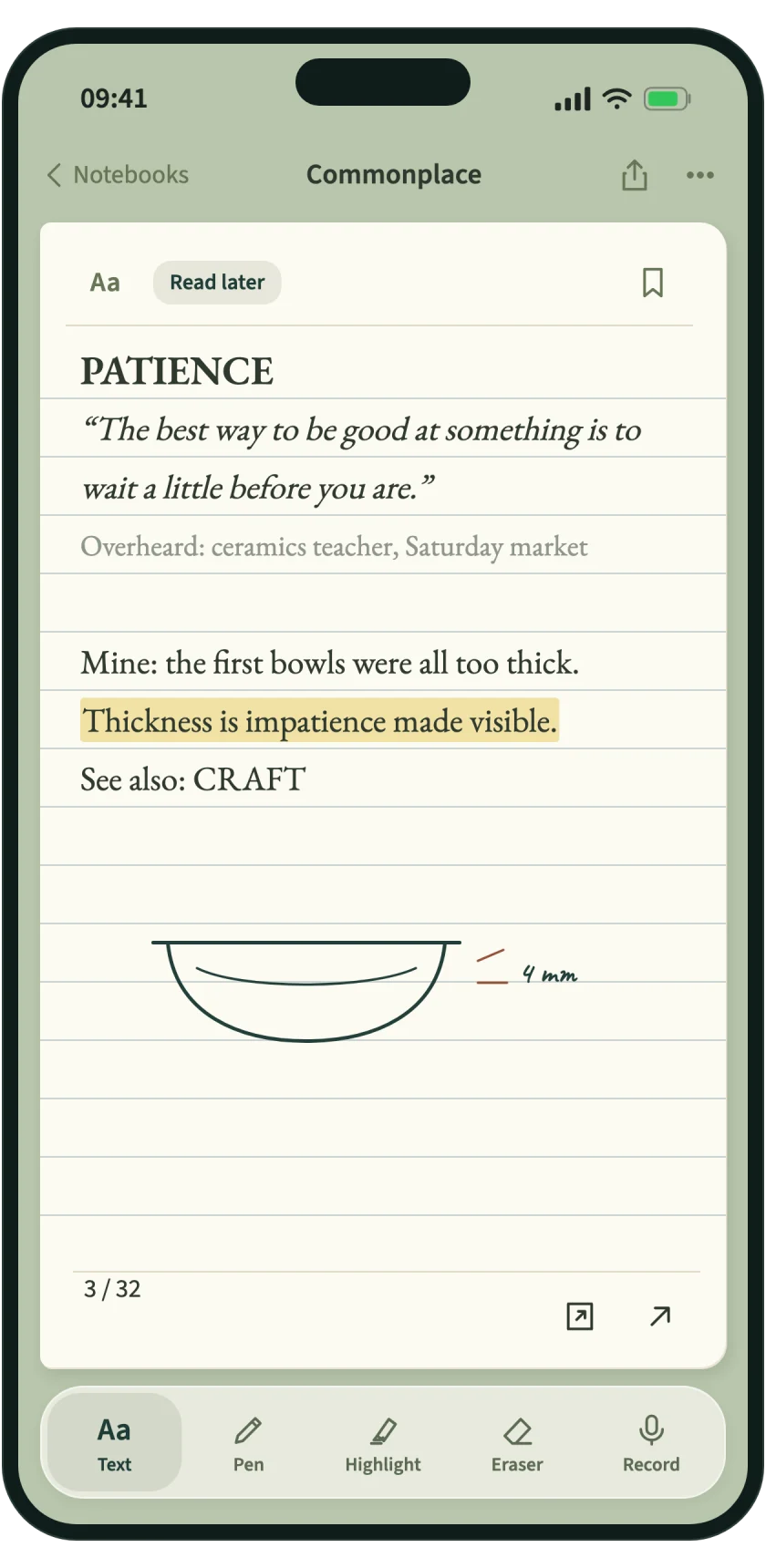
Catch the line. Open a page and type it. If you can't type fast enough, record it; on supported iPhones you can transcribe the recording later and set down the exact words and the source.
Give it a head. Fount notes doesn't keep an index page for you, and it has no tags. So do what Locke did: put the head word at the top of the page, as a Page heading. One word, chosen by you.
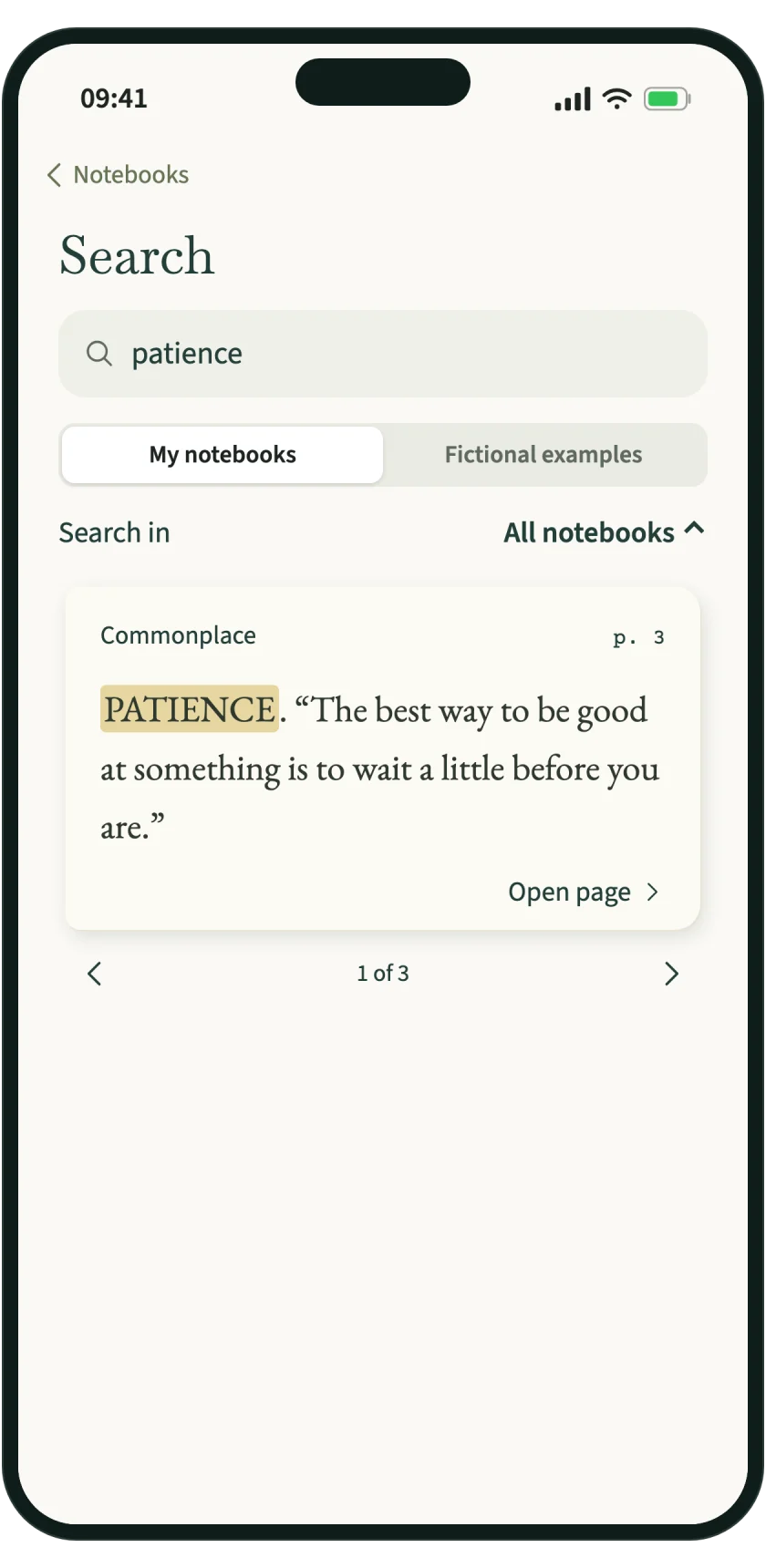
Let Search be the index. Locke's grid was a way to find a word without reading the whole book. Search does that now: type the head word, and it finds it in all your books or in one, with the book and page. Because you chose the heads yourself, the right pages come up.
Reread. Tap the bookmark on a page you want to come back to: Read later, or a reminder for a set time. Those pages wait in Review, one at a time. And when you just want something to read, open your own book and turn the pages.
One book per field. With Fount Plus you can keep more than one book, as Locke suggested: one for work, one for the kitchen, one for the garden.
Where paper wins: a paper commonplace book is lovely to leaf through, and copying a passage by hand slows you down enough to read it properly. Plenty of people keep both. You don't have to, though. A page in Fount notes is already a complete entry. Nothing needs copying over for the system to work.
Tomorrow
Catch one sentence you hear or read and want to keep. Type it exactly, with where it came from, and add one line of your own. Put a single head word above it. In a week, search for that word.
Sources
- John Locke, A New Method of Making Common-Place-Books (French 1686; English 1706), Clarendon edition
- Richard Yeo, on Locke's method and its publication history (2023)
- Darwin Correspondence Project, letter from Charles Darwin, 4 April 1879