
Field notes the Grinnell way: look, note, look again
A museum method from 1908 that turned into a measurement a century later. You only need the first two parts to start.
4 min read
The kingfisher is gone in two seconds. A blue flash, low over the water, upstream. If you're still writing a tidy sentence about the heron, you've missed where it went.
In 1908 Joseph Grinnell became the first director of the Museum of Vertebrate Zoology at the University of California, Berkeley. He sent students and staff all over California to record birds, mammals and reptiles, and he was strict about one thing above all: the notes. You can't know in advance which observation will matter, he wrote that year. "Do record them all!"
In 1910 he explained why. The greatest value of the museum's records, he wrote, might not show "until the lapse of many years, possibly a century".
He was close. In the early 2000s, researchers from the same museum went back to the sites in Yosemite that Grinnell's teams had surveyed between 1914 and 1920. Using the old field notes, they could reconstruct what had been found where. Half of the 28 small-mammal species they followed had shifted their range uphill, by about 500 metres on average. A century-old notebook had become a measurement.
You don't have to be a zoologist to use the method. It works for anyone who goes outside and pays attention: a birdwatcher, a walker, someone watching the same street change through the seasons.
The whole system, in four parts
Grinnell's people kept at least four records, linked by date and place.
1. The field notebook. Small and always with you. You write in it on the spot: times, numbers, what an animal did, the details you won't remember tonight. Rough is fine. The point is to get it down and look up again.
2. The journal. The same day, you write it out properly. Grinnell's collectors wrote on the day of observation, in permanent ink, on one side of the paper. Each entry starts with date and place, then route, weather, landscape, and what you saw and heard, in full sentences and in the first person. Grinnell preferred that kind of account to filling in cards. Add a species list, a sketch, a small map. Steven Herman, who wrote a manual on the method in 1986, gave it a motto: no journal this day, no sleep this night.
3. Species accounts. A page for each species, or for anything you keep coming back to, where you gather observations across days and years. Every time the grebes on your canal do something, it goes on the grebe page, with the date. In time these pages become your own small reference book.
4. The catalogue. A numbered list of what you collect. For Grinnell that meant specimens: each got a number, and the same number went into the journal. For you it might be photos, sound recordings, a feather. Number each one and write that number in the journal, so one always leads to the other.
That's the whole system. If four parts feel like a lot, start with the first two. They're the heart of it.
Where the pocket notebook comes in
The field notebook is the shortest part of the system, and everything else depends on it. It's the only part that happens while the thing is happening.
It also has a job that's easy to forget: letting you look away from the page as fast as possible. The best field note is the shortest one that still lets you write the full journal entry tonight.
Doing it with Fount notes
Fount notes makes a good field notebook, especially when your hands are cold or full, or you don't want to look down for long.
Note on the spot. Open a page and type the time, the place and what you see. Fount notes doesn't record your location, so type where you are. One line is enough.
Speak instead of write. Record a sentence while your eyes stay on the bird. On supported iPhones the recording can be transcribed later, and the original sound stays on the page.
Sketch. Draw the shape of a wing bar or the posture of a heron with your finger. A rough drawing often says more than a description.
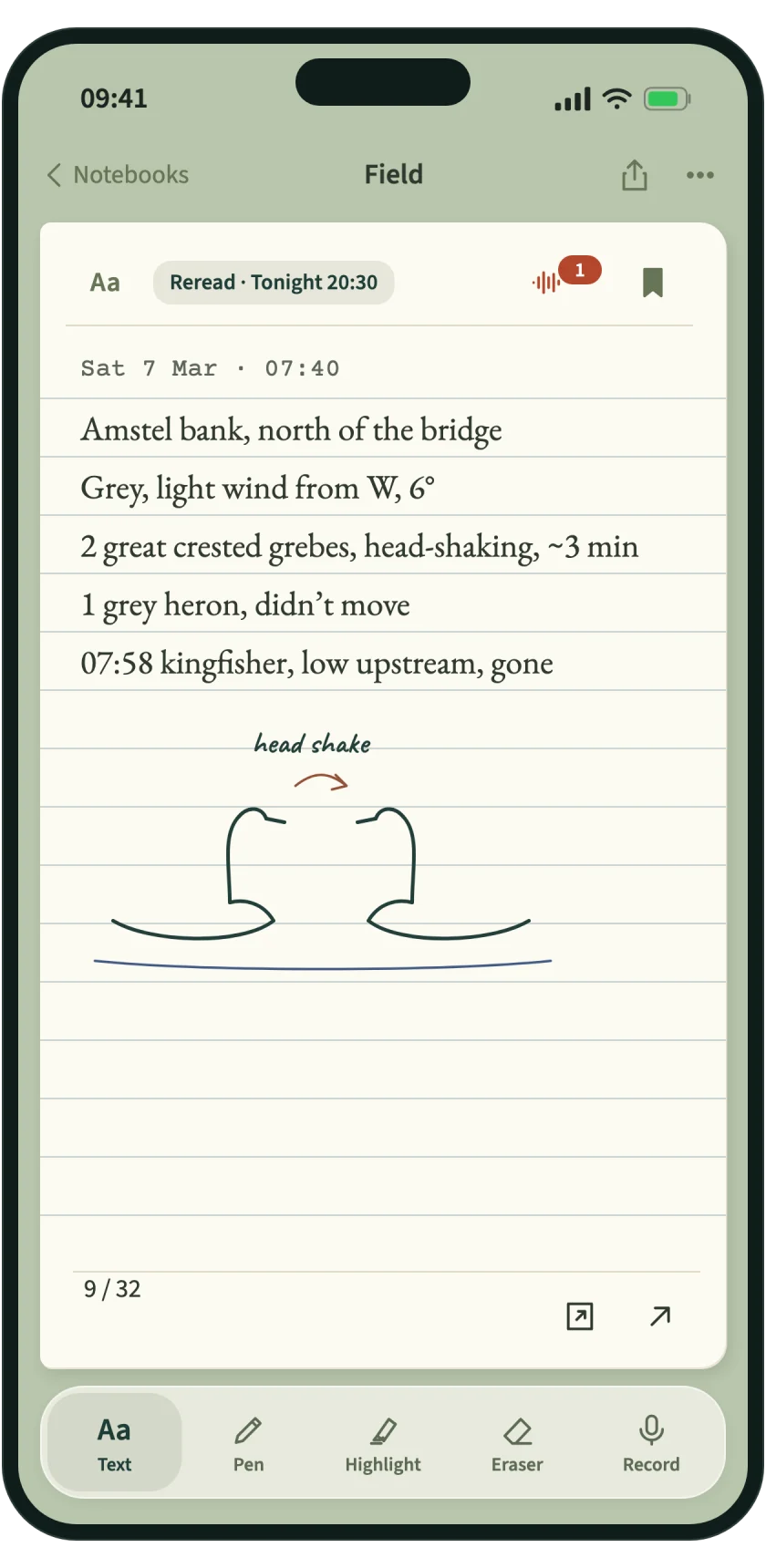
Don't skip the evening. Tap the bookmark on today's page and set a reminder for tonight. When it comes up in Review, that's your cue to write the journal.
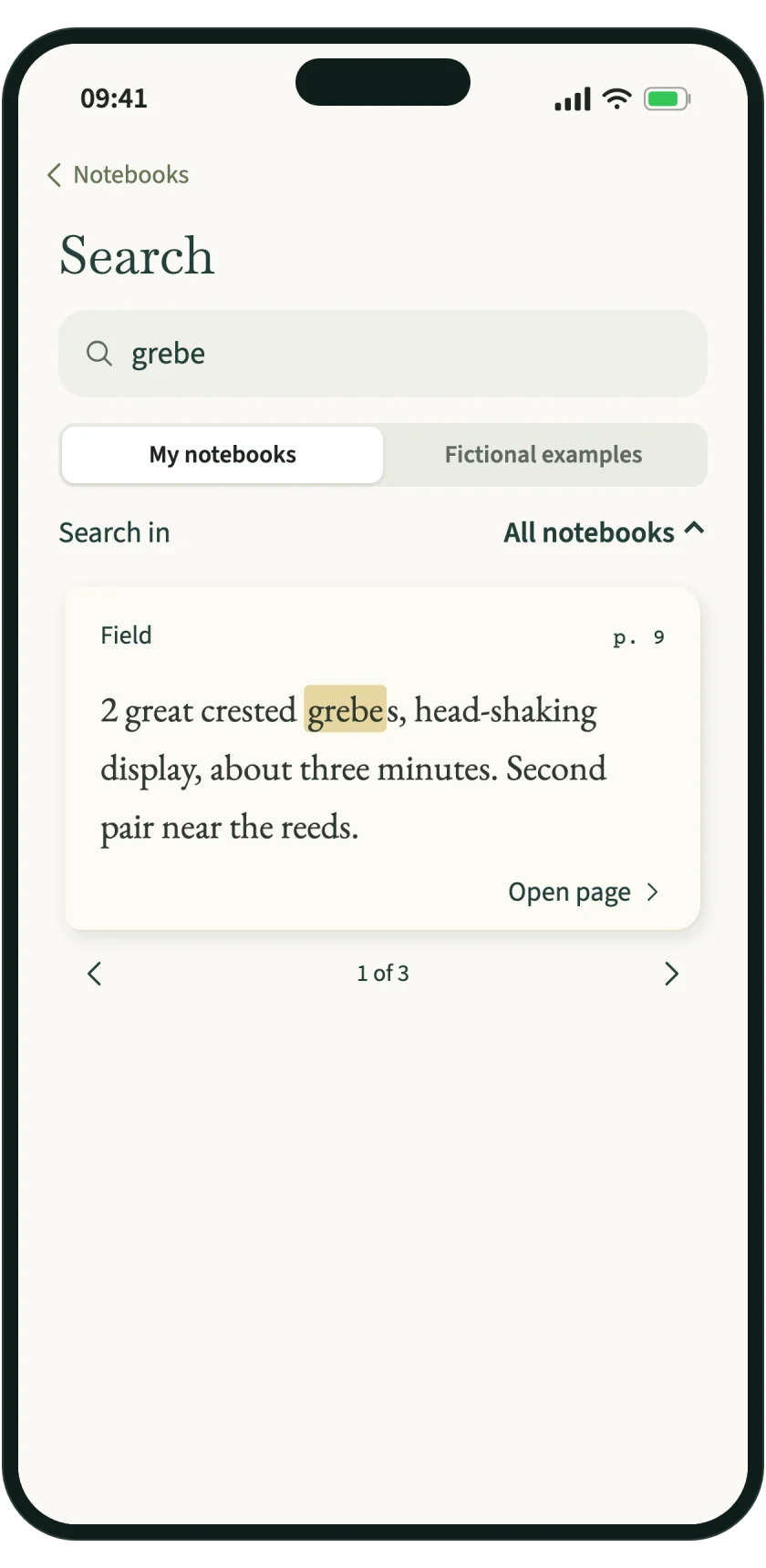
Build species accounts with Search. Search for "grebe" across your books and you get every page where you wrote it, with page numbers. That's the raw material for a species page.
Keep a copy. Grinnell wrote for an archive. Your phone isn't one. Export a page as a PDF, drawings included, or save a whole book as an archive with its recordings.
Where paper wins: the journal. Grinnell's records lasted a century because they were written in permanent ink on good paper and kept in a museum. If you want your journal to last, write it in a bound notebook or keep it in your own files, and use Fount notes for what it does best, the moment outside. Or keep everything in the app if that suits you. The system works either way, and nothing needs copying over to be complete.
Tomorrow
When you're outside, make three short notes in Fount notes: one typed, one spoken, one sketched. Set a reminder for the evening. When it comes up, write five sentences: date, place, weather, and what you saw. That's your first journal entry.
Sources
- Joseph Grinnell, "The Methods and Uses of a Research Museum", Popular Science Monthly (1910)
- Museum of Vertebrate Zoology, "The Grinnell Method" / field notes pages — mvz.berkeley.edu
- Craig Moritz et al., "Impact of a Century of Climate Change on Small-Mammal Communities in Yosemite National Park, USA", Science (2008)
- Steven G. Herman, The Naturalist's Field Journal (1986), via Keay (1992)