
The deep thinking list
A short list of things worth more than a quick answer. Once a week, an hour or two away from everything, with only a pocket notebook. Then you wait to see what stays.
5 min read
This system doesn't come from a book. It's the one Nico Oud, who makes Fount notes, uses himself, and the one he credits with getting him through every big challenge so far. It has one list, an hour or two a week, and one pocket notebook. That's all of it.
It does borrow from a few good ideas. Cal Newport calls work that needs your full, undistracted attention deep work. In 2015 he described a habit of keeping "a single, clear problem" ready to think about on walks and commutes. The pair signal and noise comes from communication engineering, and Claude Shannon gave it its classic form in 1948: the signal is what carries the message, the noise is everything that gets in its way. And in 1926 Graham Wallas described how a thought often arrives: you prepare, you let it rest, it comes to you, and then you check whether it holds. The deep thinking list turns those ideas into a habit you can keep.
The whole system, in five steps
1. Keep the list. Whenever something deserves more than a quick answer, write it down as one line. A decision you keep putting off. A problem that keeps coming back. A half idea you can't place yet. This isn't a to-do list: nothing on it has a deadline, and nothing gets ticked off just because you did something.
2. Take yourself out, once a week. Block an hour or two. Go to a café, walk through the village or into the woods. Bring your pocket notebook with the list in it, nothing else. No laptop, no podcast, no messages. Newport, borrowing from Lead Yourself First by Raymond Kethledge and Michael Erwin, describes solitude as a state "isolated from input from other minds". That's what you're after. You can be alone in a full café.
3. Go through the list. Then put it away. Order a coffee or a tea. Look around. Don't pick a topic and don't start working. Just wait.
4. Notice what stays. After a while, one thing keeps coming back on its own. That's the signal. The rest is noise for this week. It isn't deleted; it stays on the list for another week. You don't decide what to think about. You let it come to you.
5. Write when it flows. When the ideas come, write them down in short sentences. Don't tidy them up. Sometimes it's three lines. Sometimes you fill a whole pocket notebook with sketches and arrows, because one idea wants to be worked out in detail. The strength, as Nico puts it, is letting your creativity lead. It decides whether you write, how much and for how long.
At home, work out what's worth keeping. Nico does this in broad strokes, in a paper notebook or on his reMarkable, and then in Capacities or Notion. That's where the thinking turns into a plan.
Why it works
The list starts Wallas's first step: every line is something you've already met and turned over a little. The walk or the café is the second step, the rest. Research backs this up. A 2009 review of 117 studies by Sio and Ormerod found that stepping away from a problem helps, and helps more after longer preparation. In 2014, Oppezzo and Schwartz at Stanford found that people came up with more ideas while walking than while sitting, indoors or out, and the effect lasted a little after they sat down. Walking helped with finding ideas, not with tasks that have one right answer. That fits: the session is for ideas, the work at home is for checking them.
The list also takes away a quieter pressure. You don't have to decide in advance what deserves your attention. You only have to show up.
Where the pocket notebook comes in
The pocket notebook is the only thing you bring. It holds the list, and it catches what comes. It's small enough that it doesn't turn the café table into a desk. And it's fast: an idea that arrives mid-walk goes down in a few words before it fades, and you're back to looking around.
Nico used to keep the list in a paper pocket notebook. Now it lives in his book in Fount notes.
Doing it with Fount notes
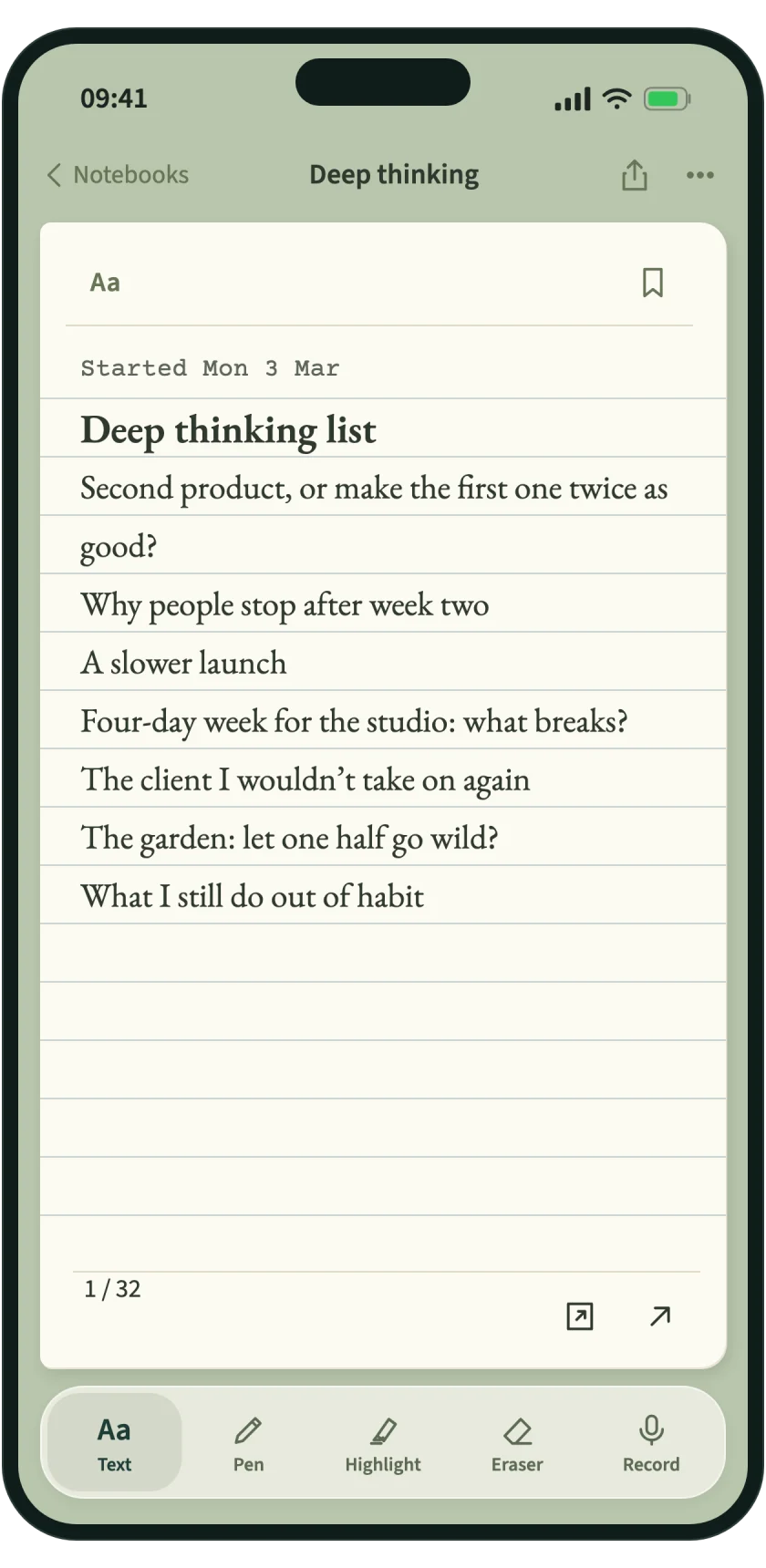
Keep the list in Fount notes. Things to think about don't wait for the weekly hour. They come up in a meeting or on the train. Give the list a page with a heading at the top, and add a line whenever something surfaces. With Fount Plus you can give it a book of its own.
Before you go, turn on Airplane Mode. Your notes are stored on your iPhone, with no account, so Fount notes works without a connection, and nothing else can reach you. Go through the list, then put the phone away.
When it flows, turn to a fresh page and write the short sentences. On a walk, you can also speak a sentence and keep walking; on supported iPhones, the recording can be transcribed. If an idea is a shape before it's a sentence, sketch it with your finger.
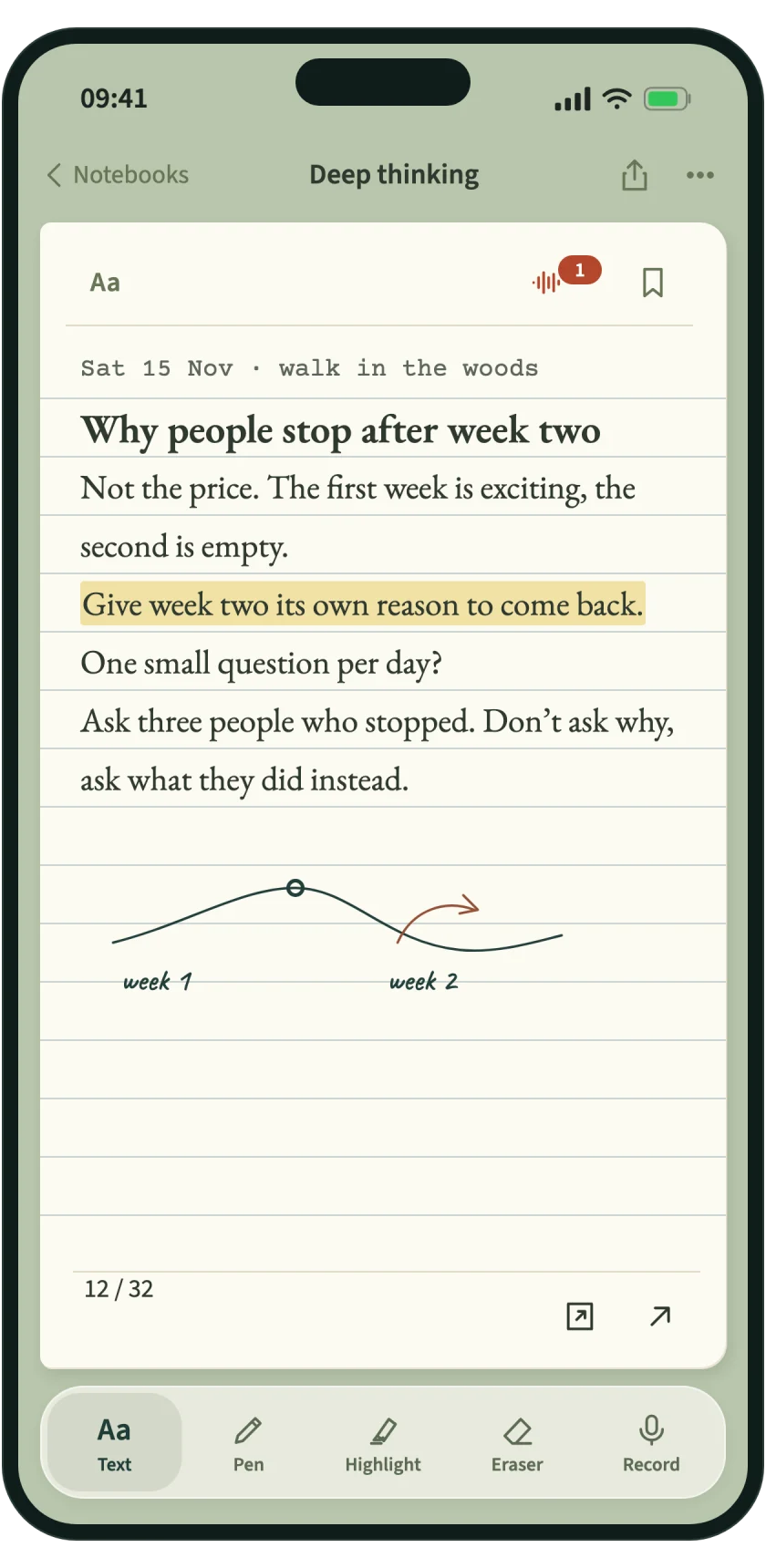
At home, Search finds the half idea from three weeks ago and shows the book and page. With Fount Plus, you can send a page's text to Capacities or Notion and work it out there. Drawings and recordings stay in the book.
Put the weekly hour in your calendar, like a meeting you can't move.
Tomorrow
Start the list. Write down five things you keep coming back to, one line each. Then pick an hour this week and put it in your calendar. When it comes, leave everything behind except your pocket notebook. Go through the list once, order a coffee, and wait.
Sources
- Nico Oud, maker of Fount notes, his own description of the system (November 2026)
- Cal Newport, Deep Work (2016)
- Cal Newport, "Deep Habits: Think Hard Outside the Office" (2015) and "Spend More Time Alone" (2017), calnewport.com
- Raymond M. Kethledge and Michael S. Erwin, Lead Yourself First (2017)
- Graham Wallas, The Art of Thought (1926)
- Claude E. Shannon, "A Mathematical Theory of Communication" (1948)
- Ut Na Sio and Thomas C. Ormerod, "Does Incubation Enhance Problem Solving? A Meta-Analytic Review", Psychological Bulletin (2009)
- Marily Oppezzo and Daniel L. Schwartz, "Give Your Ideas Some Legs", Journal of Experimental Psychology: Learning, Memory, and Cognition (2014)