
Getting Things Done, with the in-tray in your pocket
David Allen's five steps fit on one page. The first one only works if you can catch a thought wherever it turns up.
5 min read
You're in the car park after a meeting. Someone said "before Friday noon", and you nodded. By the time you're home, that phrase will be tugging at you while you cook.
That tug is where David Allen started. A consultant who had spent years coaching people in demanding jobs, he published Getting Things Done in 2001 (a revised edition followed in 2015). His point is simple: anything you've agreed to do keeps pulling at your attention for as long as it lives only in your head. In a 2019 interview he put it this way: "Your head's for having ideas, not for holding them."
GTD is a way to get those things out of your head, and to trust the place where you put them.
The whole system, in five steps
- Capture. Collect whatever has your attention in a few places you'll actually check: an in-tray, your email, a notepad. Don't sort yet. When Allen starts with a new client, he hands over a stack of printer paper and asks what's on their mind. One item per sheet, into the tray.
- Clarify. Later, take each item in turn and ask: is this actionable? If not, it's trash, reference, or something for a someday/maybe list. If it is, decide the very next physical action. Under two minutes? Do it now. Someone else's job? Hand it over and note that you're waiting. More than one step? It's a project.
- Organize. Put each result where it belongs. Actions with a date go on your calendar. Other next actions go on a list. Things you've handed over go on a Waiting For list, projects on a project list, reference wherever you'll find it again.
- Reflect. Look at your lists often, and once a week do the Weekly Review. Allen's checklist has three parts. Get clear: gather loose papers and notes, process your in-tray to zero, empty your head. Get current: go through your calendar, actions, Waiting For and projects. Get creative: read your someday/maybe list and add new ideas.
- Engage. Choose what to do now, using your lists and what the moment allows.
Where the notebook comes in
The system usually breaks at step one. If you can't capture something the moment it shows up — in the car park, mid-conversation, on a walk — it slips back into your head, and your head stops trusting the system. Allen wants capture tools to be as ordinary as a toothbrush. In the 2019 interview he mentions the small notetaker wallet he carries. That day it held a single note: "chiropractor".
A pocket notebook does that job. Your actions don't live in it. It's the in-tray you take with you.
Doing it with Fount notes
Capture: one loop per page. Type it, sketch it, or say it out loud when typing won't work. On supported iPhones a recording can be transcribed. If your hands are full, tell Siri "Add a note in Fount notes". It asks "What would you like to note?", and you answer. A widget on your Home Screen gets you to a page just as fast.
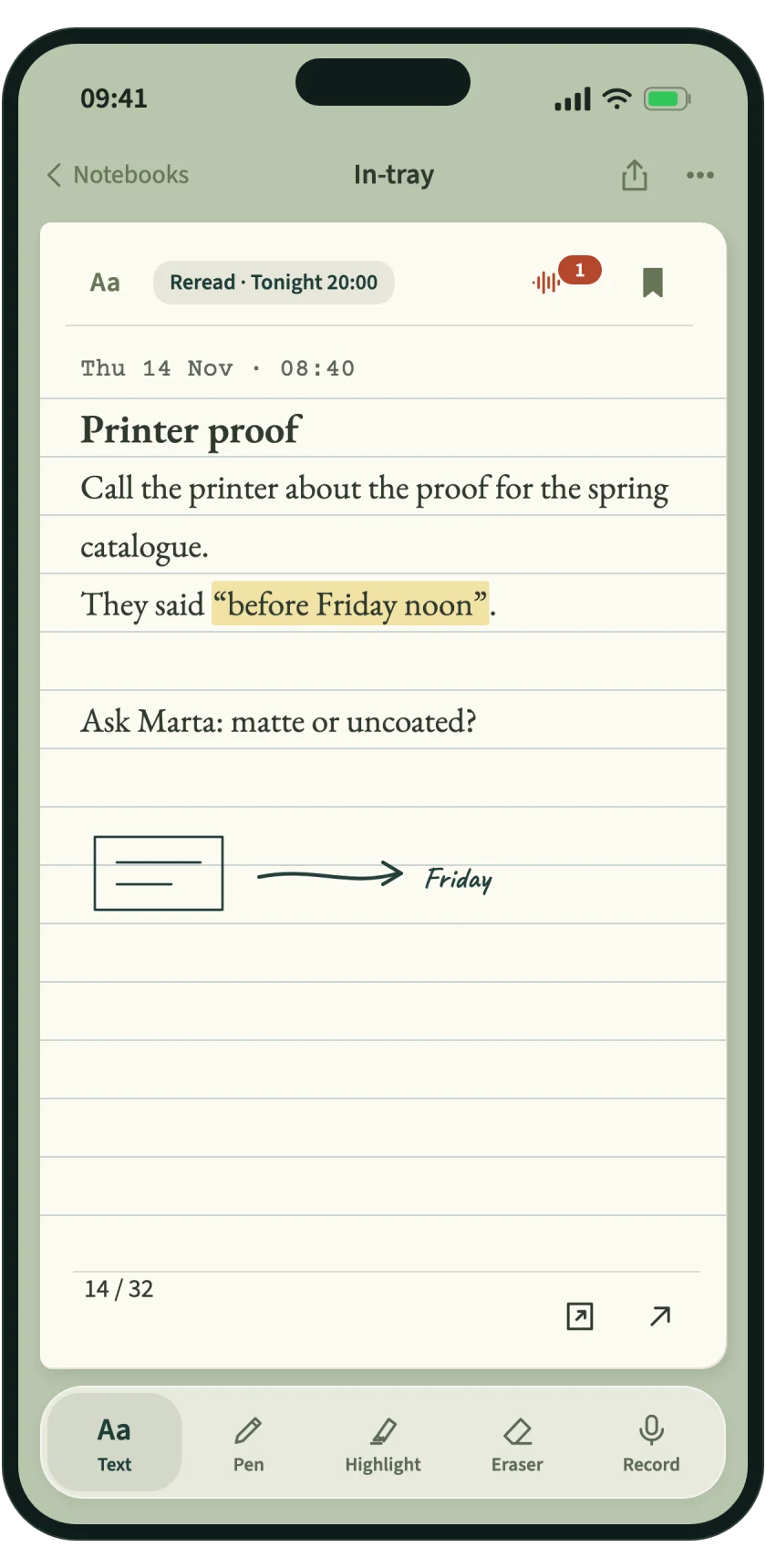
Mark it for later. Tap the bookmark on a page that still needs a decision and choose a time, tonight for instance. Every page with a reminder ends up in Review, a stack you go through one card at a time. That stack is your in-tray. Getting to zero means getting through the stack.
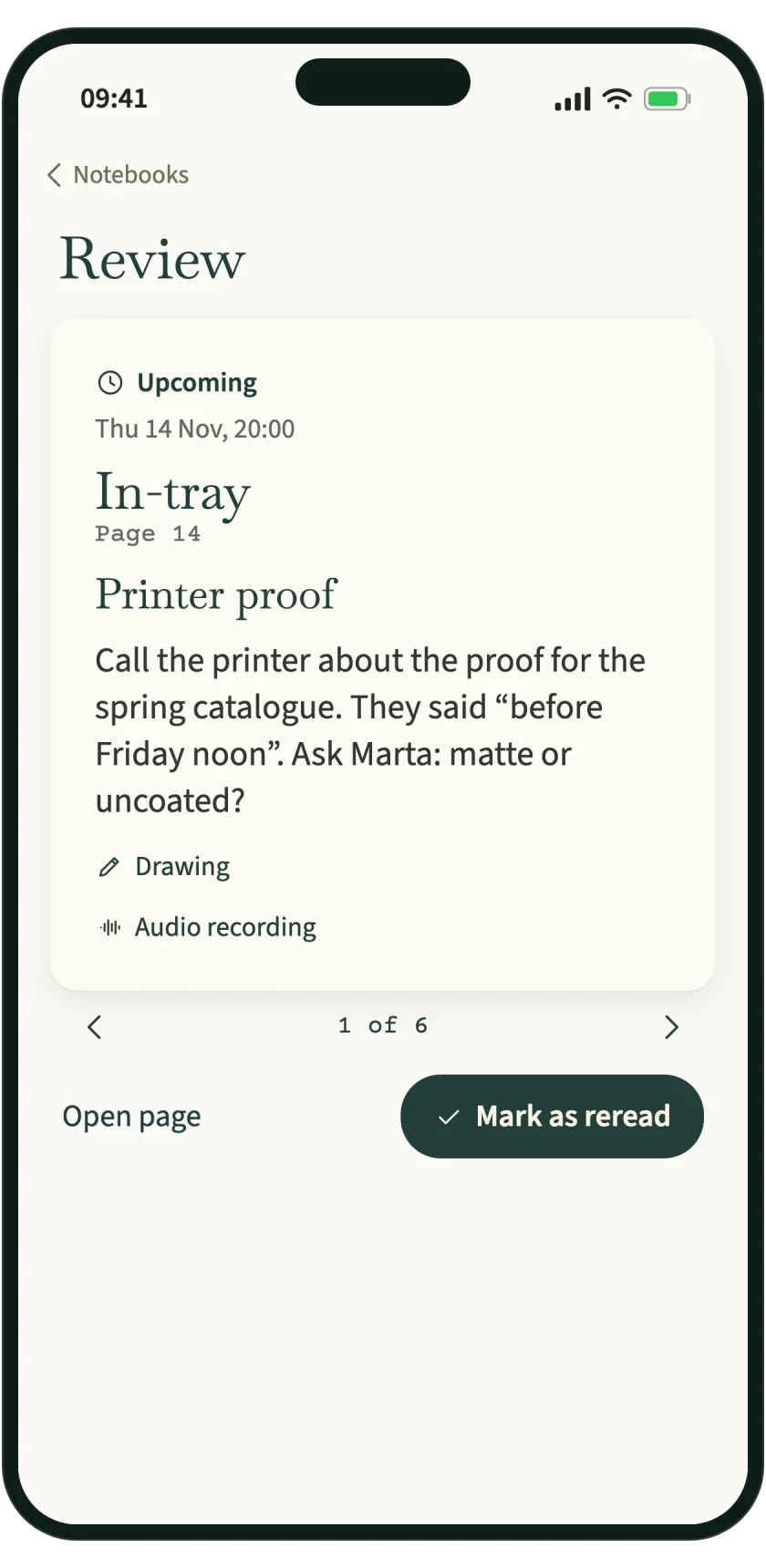
Clarify and organize. Go through Review and decide on each page. Trash: tear the page out. It's set aside in the notebook, and you can put it back. Reference: leave it where it is. Search finds it later by any word on the page and tells you which book and page.
Actionable is where Fount notes hands over. It isn't a task manager and doesn't try to be. With Fount Plus you can send a page to Apple Reminders or Things: the page's text goes into a single reminder or becomes one to-do, and the page stays in your book. That's why one loop per page matters. Without Plus, write the next action into whatever list you already use, on paper or in an app. That isn't copying. Deciding the next action is the clarify step, and the result is nearly always shorter and clearer than what you captured.
Reflect. "Gather loose papers and notes" includes your pocket book. Page back through the week, check that every page has had its decision, and empty whatever is still on your mind onto a fresh page.
Engage happens in your lists and your calendar, not in Fount notes.
When paper or another tool does it better
If you always carry a paper notebook and like a paper list of next actions, keep them. GTD works fine on paper; Allen starts his own clients with printer paper. Fount notes earns its place when the paper isn't with you, when you want someone's exact words, or when the thought arrives as a sketch or a sentence you'd rather say than type. The lists themselves belong in a task app or on paper. Contexts, due dates and repeating actions are what those are for.
GTD has its critics, too. Cal Newport, writing in The New Yorker, argued that the real problem is how organisations hand out work, and that no personal system can fix that on its own. Fair enough. A notebook won't fix it either. It just makes sure the thing you nodded at in the car park doesn't get lost.
Tomorrow
Tonight, put a Fount notes widget on your Home Screen. Tomorrow, capture every loose commitment as it comes up, one per page, without sorting. In the evening, page back through the day and ask each page Allen's one question: is this actionable? Write down the next action, tear the page out, or leave it as reference. That's capture and clarify in a single day. Add the Weekly Review on Friday.
Sources
- David Allen Company, "What is GTD?" — gettingthingsdone.com
- David Allen Company, "Weekly Review checklist" (PDF) — gettingthingsdone.com
- The Tim Ferriss Show, episode with David Allen, transcript (2019)
- Cal Newport, "The Rise and Fall of Getting Things Done", The New Yorker (2020)