
The Bullet Journal, and the days it stays at home
Ryder Carroll's method lives on paper, and it should. Here's the whole of it, plus what to do when the notebook is on your desk and you're not.
4 min read
Ryder Carroll was a digital designer in New York when he built the Bullet Journal for himself, with the only tools he really had to hand: pen and paper. He has written that his ADHD often left him feeling his mind was unfit for traditional education systems. In 2013 he put the method online with a short video and step-by-step instructions. The book, The Bullet Journal Method, followed in 2018. The official site describes it as part productivity system, part mindfulness practice, built around one idea: intentionality.
It's a paper system. That's worth saying first, because it stays one.
The whole method
1. Rapid logging. Everything goes in as short, plain lines with a symbol in front:
- • a task
- ○ an event
- – a note: a fact, an idea, something you noticed
Tasks change as you go: × when done, > when you move it forward, < when you schedule it into the Future Log. Two optional marks sit in front of a line: * for priority, ! for inspiration.
2. Index. Leave the first pages free and call them Index. Number your pages. When you start a topic, write its name and page numbers there ("New Zealand trip: 5–10, 23").
3. Future Log. A spread divided into the months ahead, for things that belong to later.
4. Monthly Log. Each month gets two pages. On the left, the dates down the margin with short entries for events. On the right, that month's tasks.
5. Daily Log. Write today's date as a heading and log through the day. If the page isn't full, tomorrow carries on below.
6. Collections. Pages for things that belong together: a reading list, a project, a course. They go in the index too.
7. Migration. At the end of the month, go over your open tasks and ask each one: does this still matter? If not, strike it out. If it does, write it again in the new month or a collection, and turn its • into >. The rewriting is on purpose. Carroll's point is that if something isn't worth writing twice, it probably isn't worth doing.
8. Reflection. The method keeps asking you to stop and look: at the end of a day and at migration. Not to judge yourself, but to see what deserves your time.
The gap: days without the journal
A Bullet Journal works when it's with you. The trouble is the days it isn't. It's on your desk while you're in a queue, on a bike, or somewhere without a table. The Bullet Journal team knows this. Their own app is meant for logging tasks, events and notes "when away from your notebook", and it says plainly that it isn't designed to replace one.
Fount notes can fill that gap. It doesn't replace the journal either.
Doing it with Fount notes
One away log per day. Open a page, put the date at the top and log the way you would in the book: a dot for a task, an o for an event, a dash for a note. The Task and Bullets formats work too, and you can draw a symbol with your finger, since a page takes both typing and sketching. When typing isn't possible, say the line out loud. On supported iPhones a recording can be transcribed. Siri helps as well: "Add a note in Fount notes."
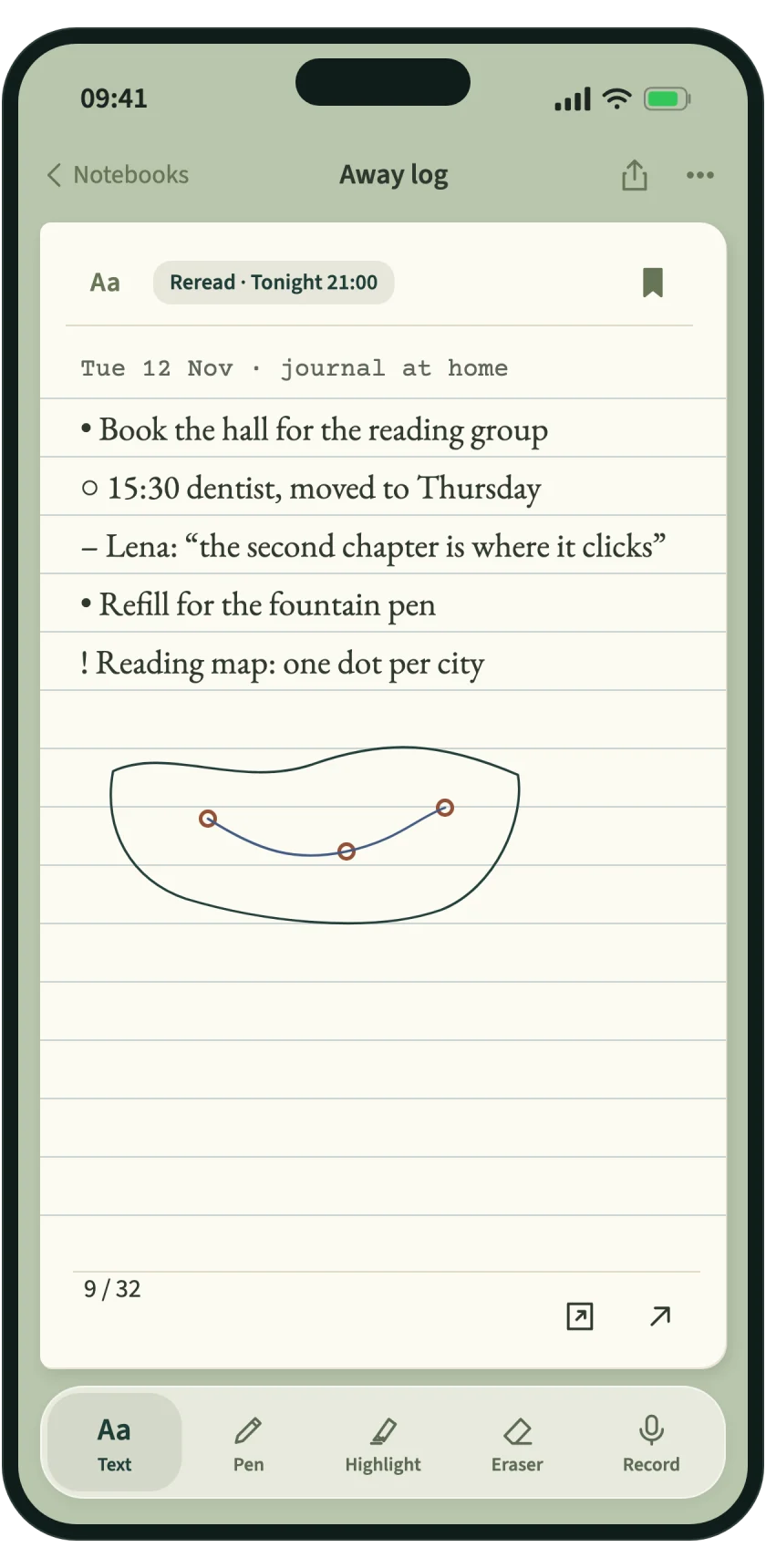
Bookmark it for migration. Tap the bookmark on the page and set a reminder for tonight. In the evening Review shows the pages you marked, one by one. Sit down with your journal and migrate: tasks that still matter go into today's or this month's log, notes that belong in a collection go there, and the rest you let go. Then tap Mark as reread. Copying it over isn't a workaround. It's migration, and the rewriting is the point.
Or leave it where it is. Some things don't need to move: someone's exact words, a sketch of a route, a voice recording. Leave them in Fount notes and write one line in the journal that points to them: "– Lena's quote: Fount, Tue."
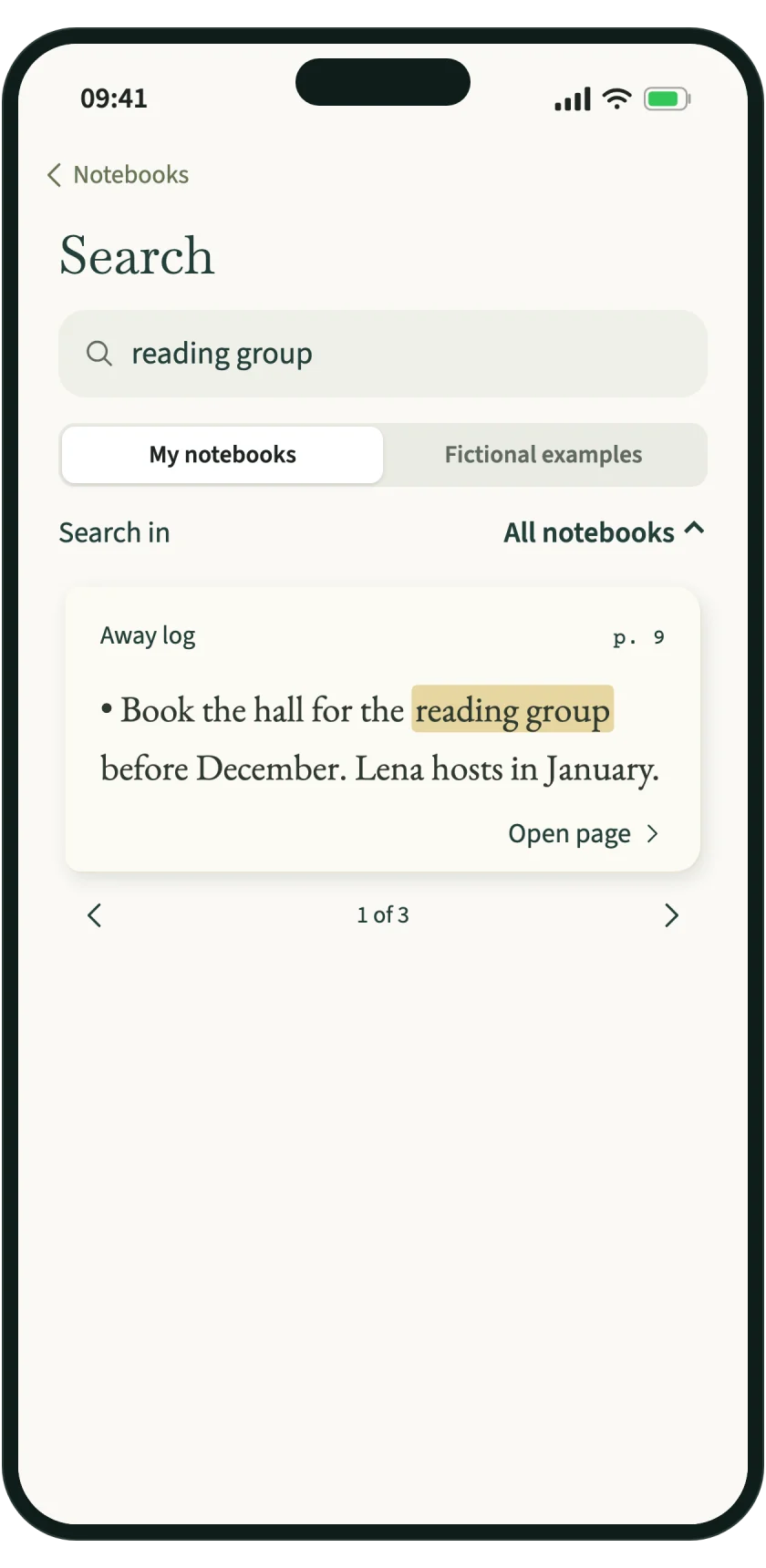
Use Search as a second index. Your paper index finds topics. Search finds words, across all your books or in one, and shows the book and page. It's handy for the thing you only half remember. It's a lookup, though, not an index you keep.
Where paper wins
The Future Log, the Monthly Log and migration from month to month belong on paper. Fount notes has no calendar spread, and it doesn't keep an index or a table of contents for you. Paging back through a year in your own handwriting is a different thing from scrolling. And a notebook doesn't light up with messages. The Bullet Journal site calls its mostly analog format a way to cut down on digital distraction. Your phone is the opposite, so use it for the moment, not as the journal.
Tomorrow
Make one page in Fount notes called "Away log". Every time something comes up while your journal is out of reach, log it there with a symbol in front. Bookmark the page for tonight. In the evening, open your journal, migrate the page, and notice which lines didn't survive the question: does this still matter?
Sources
- Ryder Carroll, "Our story" — bulletjournal.com
- Bullet Journal FAQ: rapid logging, index, future log, monthly log, daily log, collections, migration — bulletjournal.com
- Ryder Carroll, The Bullet Journal Method (Portfolio, 2018)
- Bullet Journal Companion app listing, App Store